ATTENTION MANAGEMENT FOR SCATTERED MINDS
Reset your attention. Find your next clear action.
unscatter is an attention management brand for scattered minds. Built on the principle of removal, it helps you clarify what is occupying your attention, externalise the noise, reduce the load, and return to one clear next step.

Drag the brain to rotate it. Select a signal to explore how digital overload can feel.
Frequent context switches can make sustained focus harder to maintain.
Three guiding principles
A calmer way to work with your attention.
Understand what is competing for your attention, make room to choose and reduce unnecessary load. unscatter’s guides and tools help you move towards clearer priorities and one manageable next step.
- Competing demands→Clearer priorities
- Mental clutter→Room to think
- Unclear choices→Room to choose
- Unnecessary load→Less to carry
- Feeling stuck→One smaller step
Attention management
Notice what is pulling you in different directions and find a clearer place to begin.
Human agency
Make choices that fit your circumstances, set boundaries and keep room to change course.
The principle of removal
Set aside what adds unnecessary load, leaving more space for what matters next.
A few places to begin
What is taking up your mental space?
Different days call for different kinds of support. These themes help you put words to what is getting in the way.

Focus & getting started
Find a starting point when distractions or an unclear task make it difficult to begin.

Stress & overwhelm
Make room to pause when the demands around you feel bigger than the space you have.

Cognitive load
Understand what is taking up mental space, from open loops to too many things to hold in mind.

Time & priorities
Consider what matters now, what can wait and how much you can realistically take on.

Meet unscatter
Attention management tools for real life.
unscatter brings together practical reflection tools and research-informed guides for the moments when your mind feels crowded. Our starting point is simple: understand the situation before asking more of yourself. That means looking at what has your attention, what competes with it and what you can change.
Work, study, creative projects and caring responsibilities can all ask for attention at once. A useful response needs to fit your circumstances, your available energy and what matters to you.
Our principle of removal begins before another system is added. What could be reduced, clarified or put down? Sometimes the next step is a smaller action. Sometimes it is a boundary, a pause or another person’s support. You keep room to choose.
A little clarity, in practice
Understand what’s in the way, then choose one smaller step.
Start with one thing taking up your attention. Clear Mind offers a short, guided reflection to help you describe the situation and notice what may be making it difficult. You do not need to untangle everything at once.
From there, consider a response that fits: clarify an unclear task, make a smaller commitment, set a boundary, rest or ask for help. The choice remains yours, with room to reconsider as things change.
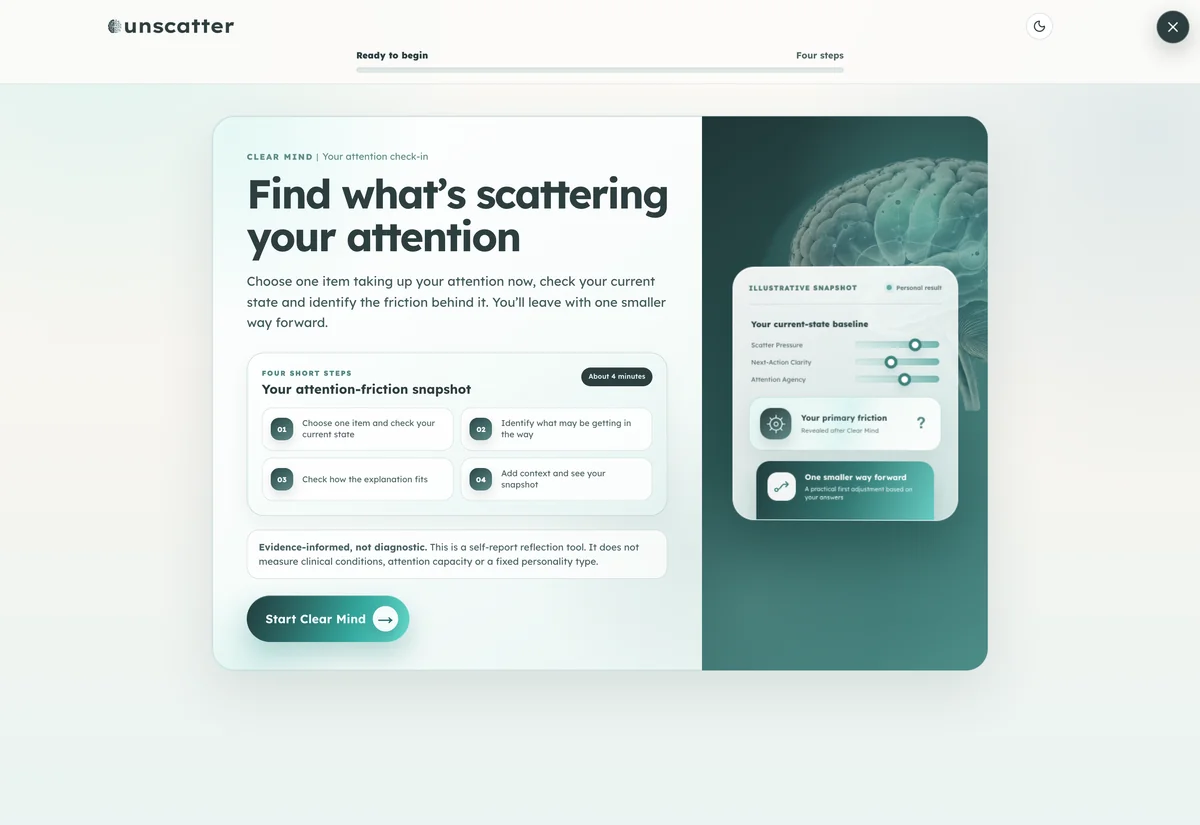
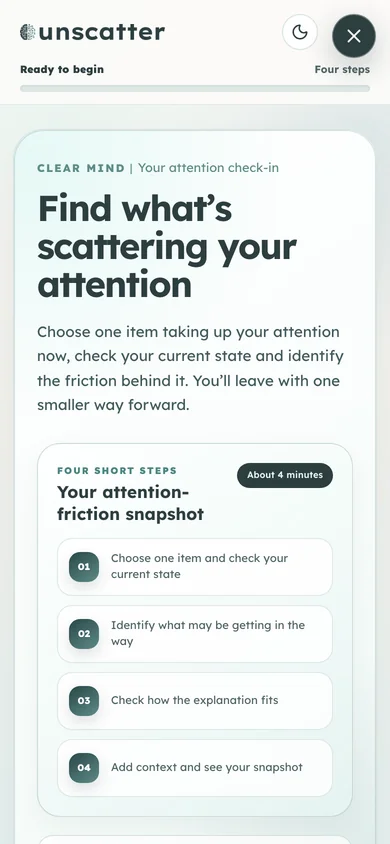
- Free
- About 4 minutes
- No account or email required
Notice
Bring one thing taking up your attention into view.
Understand
Name what makes it difficult, such as an unclear choice.
Choose
Find one smaller response that fits your situation.

A thought on attention
Attention works much like a muscle—use it poorly and it can wither; work it well and it grows.
Frequently asked questions
For curious minds
A closer look at attention management, Clear Mind and how unscatter works.
What is unscatter?
unscatter is an attention management brand for people who feel scattered by modern life and technology. It helps you understand what is taking up mental space, reduce unnecessary load and choose a clear next step.
Who is unscatter for?
unscatter is for anyone navigating competing demands, digital overload or unclear priorities. You do not need a diagnosis or a particular productivity identity to use its guides and tools.
What is attention management?
Attention management means noticing what you engage with, what competes for your attention and what you can change to support a deliberate choice.
What does human agency mean at unscatter?
Human agency means having enough room and support to choose, reconsider a goal, change course, set a boundary or ask for help.
What is the principle of removal?
The principle of removal asks what could be reduced, clarified, delayed or put down before another productivity system is added.
What is Clear Mind?
Clear Mind is a free self-reflection check about one task, decision or concern. It offers a current-state snapshot, the frictions around that item and one smaller next adjustment.
Is Clear Mind a diagnosis?
No. Clear Mind is a general educational reflection tool, not a medical, mental-health or productivity assessment. It does not replace professional advice or support.
What happens to my Clear Mind answers?
Your progress, answers and results stay in this browser so Clear Mind can be resumed. Optional analytics and advertising measurement record neutral process events only, with your separate consent; they exclude reflection text, selected answers, demographics and result codes. You can use the check and read the result without an account, email address or tracking consent. Newsletter signup is separate and optional.